End of Life Care Profiles
The End of Life Care Profiles aim to increase the availability and accessibility of information on end of life care across England.
These are available on PHE's Public Health Profiles/End of Life Care Profiles
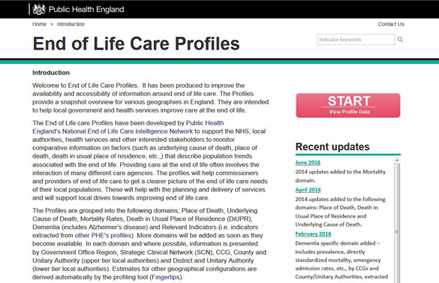
The data in this tool is organised thematically under six domains: place of death; death in usual place of residence (DiUPR), underlying cause of death, mortality, dementia, and other contextual indicators. It includes over 80 indicators encompassing data from 2004 – 2014.
Spatial variations can be compared over time within the following geographies: Unitary Authorities, County Authorities, Local Authority Districts, Clinical Commissioning Groups, Strategic Clinical Networks, Office for National Statistics cluster groups, deprivation decile, and Government Office Region.
The data is presented in table, map, chart and trend format. They can be used by anyone who wishes to compare the position to other in England and to track that position over time. In addition, all data can be extracted for separate analysis, plus maps, graphs, and tables can be exported to use in reports or presentations.
Other Resources
The Data and analytical tools page provides links to a range of other data and analytical tools and resources relating to end of life care.
PHE data and analysis tools for access to over 100 public health data and analytical tools from across Public Health England.
The original End of life care profiles were launched in InstantAtlas and these are available at Local Authority and clinical commissioning group level.